

Saudi Arabia Fire Pump Demand Is Strengthening with Giga-Projects and Civil Defense Compliance

Saudi Arabia’s fire pump sector is becoming more important as the Kingdom expands industrial zones, giga-projects, logistics facilities, airports, hospitality assets, high-rise buildings, and data centers. Fire pumps maintain the water pressure required for sprinkler systems, hydrants, standpipes, foam systems, and other fire suppression networks when the normal water supply is insufficient. In large facilities and high-risk industrial locations, they are essential for emergency readiness and regulatory compliance.
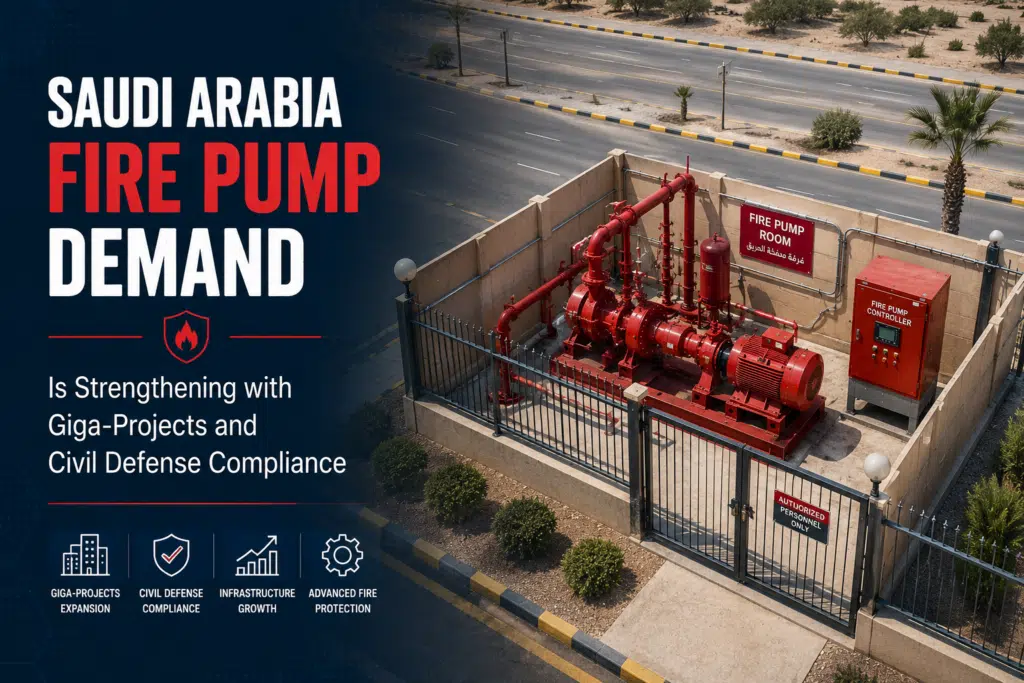
According to MarkNtel Advisors, Saudi Arabia’s fire pump sector was valued at around USD 39.63 million in 2025 and is projected to grow from USD 42.8 million in 2026 to USD 74.9 million by 2032. The in this study outlook indicates a CAGR of 9.78% during 2026–2032, supported by mega-project urbanization, mandatory Civil Defense compliance, horizontal split case pump demand, industrial end-user dominance, and localization of prefabricated fire skid systems.
Civil Defense Compliance Is a Core Growth Driver
Saudi Arabia’s fire pump adoption is strongly shaped by Civil Defense requirements and building safety codes. New industrial, commercial, residential, and mixed-use developments must include approved fire protection systems at the planning and handover stages. Fire pumps are therefore not optional equipment in many large projects; they are part of the safety infrastructure needed to secure approvals and protect occupants, assets, and operations.
Saudi Civil Defense provides fire safety regulations and requirements for facilities, including preparedness and emergency response expectations. As construction continues across Riyadh, Jeddah, NEOM-linked developments, the Red Sea region, Qiddiya, Diriyah, and industrial cities, compliance-led demand is expected to remain a major factor.
Industrial Facilities Hold the Largest Share
Industrial users account for about 59.67% share of Saudi Arabia’s fire pump demand in 2026. This reflects the Kingdom’s concentration of oil and gas, petrochemicals, mining, power generation, logistics, manufacturing, and renewable energy infrastructure. These facilities often require high-capacity, certified fire pump systems because they handle combustible materials, large storage tanks, hazardous processes, and mission-critical equipment.
Saudi Arabia’s industrial diversification agenda under Vision 2030 continues to support investment in manufacturing, logistics, tourism infrastructure, and non-oil sectors. This increases the need for fire protection systems across new production plants, warehouses, ports, airports, energy facilities, and commercial developments.
Horizontal Split Case Pumps Lead Product Preference
Horizontal split case pumps are the leading pump type in Saudi Arabia’s fire pump sector. Their dominance is linked to high flow capacity, stable pressure performance, operational durability, and easier maintenance access. These pumps are widely used in oil and gas facilities, petrochemical plants, airports, large commercial buildings, industrial complexes, and logistics zones.
The split casing design allows technicians to access internal components without disturbing pipe alignment, reducing downtime during inspection and maintenance. This is particularly valuable in mission-critical facilities where fire protection systems must remain continuously ready.
Giga-Projects Are Expanding Fire Protection Requirements
Saudi Arabia’s large-scale urban and tourism projects are creating new demand for fire pumps across hotels, entertainment districts, residential communities, transport hubs, and mixed-use infrastructure. These projects often include complex building layouts, large floor areas, underground services, and high occupancy levels, all of which require carefully designed fire suppression networks.
The Saudi Building Code National Committee provides building code frameworks that guide safety and construction requirements in the Kingdom. As developers align with local codes, international engineering practices, and Civil Defense approvals, fire pump systems are being integrated earlier in project design.
Local Assembly and Skid Systems Are Emerging Trends
Localization is becoming a notable trend in Saudi Arabia’s fire pump sector. Suppliers are increasingly exploring local assembly, technical partnerships, and prefabricated skid-mounted fire pump packages. These systems can combine pumps, controllers, valves, piping, base frames, and testing documentation into factory-assembled units that are faster to install and easier to inspect.
This shift supports faster project execution, better after-sales service, improved spare parts availability, and alignment with local approval requirements. For remote giga-projects and industrial sites, prefabricated systems can reduce installation complexity and shorten commissioning timelines.
Standards and Maintenance Remain Critical
Fire pump reliability depends on proper design, installation, testing, and maintenance. In Saudi Arabia, facilities often refer to international standards alongside local requirements. The National Fire Protection Association develops widely used fire protection standards, including NFPA 20 for stationary fire pumps. These standards influence pump sizing, acceptance testing, controllers, backup arrangements, and inspection routines.
Looking Ahead
Saudi Arabia’s fire pump sector is expected to grow steadily as giga-projects, industrial expansion, Civil Defense compliance, logistics infrastructure, and data center development increase safety requirements. With the sector projected to reach USD 74.9 million by 2032 at a CAGR of 9.78%, demand is likely to remain strongest in industrial facilities, horizontal split case pumps, prefabricated skid systems, and large-scale urban developments. The long-term direction will depend on construction momentum, regulatory enforcement, localization progress, maintenance quality, and the ability of fire pump systems to deliver dependable emergency water pressure across the Kingdom’s rapidly expanding built environment.

