
Global Fertilizer Market Forecast 2025–2035: Market Expansion Driven by Food Production Demands and Sustainable Agriculture

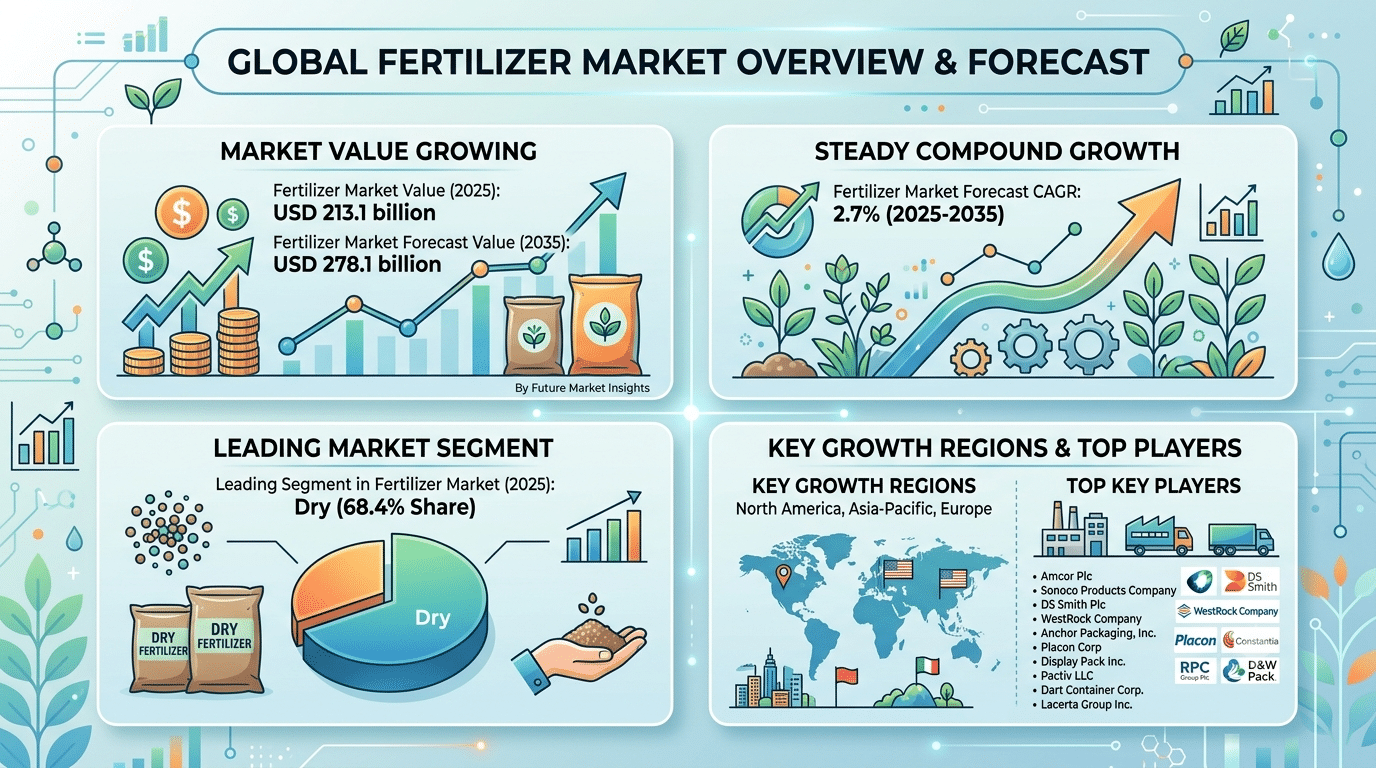
The global fertilizer market is projected to witness steady expansion over the next decade, supported by increasing global demand for food production and rising agricultural modernization across key regions. The market is expected to grow steadily, reaching approximately USD 278.1 billion by 2035, up from USD 213.1 billion in 2025, registering a CAGR of 2.7%, according to the latest analysis by Future Market Insights (FMI).
Market growth is being shaped by increasing government initiatives for food self-sufficiency, growing producer awareness regarding sustainable farming, and rapid adoption of precision farming technologies. Fertilizers have evolved into essential components of integrated nutrient management strategies to maximize crop output on limited arable land. While traditional inorganic fertilizers continue to dominate applications, manufacturers are increasingly integrating advanced systems such as biofertilizers, controlled-release, and water-soluble specialty fertilizers to comply with environmental expectations and improve nutrient uptake outcomes.
Global Fertilizer Market Snapshot (2025–2035)
- Market size outlook toward 2035: USD 278.1 billion
- Forecast CAGR: 2.7%
- Dominant application category: Agriculture (72.10% share)
- Fastest-growing segment: Specialty and advanced nutrient formulations
- Key growth countries: China, India, Germany, France, United Kingdom, USA, Brazil
- Primary demand channel: Direct farming and agricultural stakeholders
Momentum in the Market
Beginning from steady global adoption levels, the fertilizer market demonstrates sustained growth throughout the forecast period as nutrient efficiency and environmental compliance become mandatory across multiple countries. Between 2025 and 2035, expanding global population pressures and the necessity for higher crop yields are expected to significantly boost demand for optimized safety and nutrition systems. Increasing urbanization and shrinking arable land are encouraging governments and growers to prioritize advanced soil fertility technologies.
From 2035 onward, innovation in intelligent nutrient delivery methods and integration with sustainable practices is expected to further strengthen market expansion. Controlled-release fertilizers capable of adapting nutrient deployment based on soil conditions and crop cycles are emerging as key differentiators for agricultural productivity.
The Reasons Behind the Market’s Growth
Demand for fertilizers globally is rising due to multiple structural and technological factors reshaping the agricultural ecosystem.
Increasing Global Food Production Needs Rising population pressures and the urgent need to enhance crop yields have intensified fertilizer consumption, particularly across emerging economies, to ensure long-term food security.
Expanding Specialty Fertilizer Adoption The rise in specialty fertilizer usage is driven by the need for precise nutrient management. Controlled-release and water-soluble formulations deliver nutrients steadily, minimizing losses caused by leaching or volatilization.
Influence of Government Policies and Subsidies Government initiatives and subsidy programs make fertilizers affordable for small-scale farmers while policy frameworks promote balanced use to prevent over-application and environmental harm.
Growing Demand in Emerging Economies Emerging nations are experiencing massive agricultural expansion, infrastructure developments in logistics, and better farmer education programs, which collectively elevate total nutrient requirements.
Top Segment Application Type
Agriculture Leads Market Demand The agricultural sector accounts for the majority of fertilizer applications globally, holding a massive 72.10% revenue share in 2025. This reflects its critical role in enhancing the yields of staple crops such as cereals, pulses, fruits, and vegetables.
Product and Form Analysis
- Dry Form: Holds 68.40% of the total market revenue in 2025, driven by ease of storage, handling, transport, and compatibility with large-scale mechanized application equipment.
- Inorganic Products: Accounts for 54.70% of the fertilizer market revenue in 2025, supported by its proven effectiveness in delivering essential nutrients rapidly to crops at a relatively low cost.
- Specialty Fertilizers: Gaining steady traction within integrated nutrient management programs to boost environmental conservation.
Regional Development: Modernization and Ecosystem Expansion
The global market is expanding as agricultural productivity receives substantial attention across diverse geographical regions, with localized infrastructure easing supply networks.
- China (3.6% CAGR): Leading global growth, heavily supported by government initiatives promoting sustainable farming and massive large-scale manufacturing capacity.
- India (3.4% CAGR): Driven by a vast agricultural base, rising rural incomes, and a national focus on improving overall soil health.
- Germany (3.1% CAGR) & France (2.8% CAGR): Moving quickly toward precision agriculture and specialty fertilizer integration to meet strict European environmental mandates.
- USA (2.3% CAGR) & Brazil (2.0% CAGR): Sustaining high demand through export-oriented, massive industrial crop production networks.
Challenges, Trends, Opportunities, and Drivers
Drivers
- Mandates and policies for global food security
- Expanding agricultural modernization and field production
- Increasing awareness of balanced nutrient management
- Growing adoption of precision farming technologies
Opportunities
- Smart, controlled-release, and sensor-compatible delivery systems
- Biofertilizers and environmentally friendly formulations
- Lightweight and highly concentrated nutrient blends
- Tailored solutions for specific local soil and crop requirements
Trends
- Transition toward specialty and water-soluble fertilizer systems
- AI-driven soil mapping and precision application techniques
- Increased adoption of multi-nutrient blended configurations
- Sustainability-focused product and manufacturing innovation
Challenges
- High raw material price volatility (e.g., natural gas, phosphate rock, and potash)
- Supply chain constraints and geopolitical tensions impacting manufacturing costs
- Complex regulatory compliance regarding environmental runoff and emissions
Country Growth Outlook
The market’s growth trajectory is closely tied to agricultural industrialization and subsidy implementation across major economies:
- China: Leading production volumes and national sustainability enforcements.
- India: Expanding rural infrastructure and yield-optimization targets.
- Germany: High-tech agricultural practices and structural efficiency.
- United Kingdom: Localized supply security and optimized crop management.
- United States: Highly mechanized farming networks and commercial scale.
The Competitive Environment
The global fertilizer market features prominent safety and chemical technology providers competing through product innovation, regional manufacturing alignment, and compliance with strict environmental benchmarks. Key industry participants include:
- Amcor Plc
- Sonoco Products Company
- DS Smith Plc
- WestRock Company
- Anchor Packaging, Inc.
- Placon Corp
- Pactiv LLC
- Dart Container Corp.
These players, along with global chemical producers, are investing heavily in advanced coating technologies, bio-based alternatives, and operational upgrades to mitigate raw material price fluctuations while securing supply lines to global agricultural hubs.
Future Outlook: Toward Intelligent and Sustainable Agriculture
The global fertilizer market is entering a transformative decade shaped by precision technology, automation, and stricter ecological expectations. Future fertilizer systems are expected to function as highly efficient, targeted modules working alongside digital farming tools and predictive weather analytics. As global farming practices mature and sustainability awareness strengthens, advanced fertilizers will remain central to achieving safer, smarter, and more resilient food production ecosystems worldwide.
For a comprehensive strategic outlook and detailed analysis of technological developments shaping the industry, readers can explore the full report on the official Future Market Insights website: https://www.futuremarketinsights.com/reports/fertilizer-market

